Storytelling Through Landscape and Movement
Journey through a selection of previous artworks by Deborah Bonar, paintings woven with stories, emotions, and exploration of connections to land in modern Australia. Here is an insight into where it all started with my artist journey of earlier artworks. Click on painting image to load gallery.
Learn and explore the Stories to these painting by the artist, click here to load stories.


.jpg "Ruby's Country")


Perth based Aboriginal contemporary artist Deborah Bonar has completed numerous Public Art Commissions, Corporate Art Workshops and School Community Art projects during her artistic career, click on the links below to see.
.jpg "Painting titled Rainbow Sunset by Deborah Bonar")
.jpg "A Giant Teacup Sculpture with painted Aboriginal art")
.jpg "Dolphin painted by Deborah Bonar with Perth's community")
.jpg "Pundulmurra Health and Community Services Training Centre")
.jpg "Part of the Maternity Ward corridor at St John of God Midland Hospital")
.jpg "Artwork titled Bush Medicine in Armadale Hospital")
.jpg "A 2.45 x 3.3 metres ochre and mixed media painting on canvas")
.jpg "It features local wetlands and relates to local Nyoongar history")
.jpg "The artwork represents Beeliar Boodjar. the land and the sea.")
.jpg "Cockburn's Integrated Health large glass artwork for 2 airlock entries")
.jpg "an integrated glass artwork with a vibrant day and night time presence")
.jpg "Embellished photographic portraits by Deborah Bonar")
Public Art
The Munday Wall – Cooling Brothers Glass Company
Deborah Bonar created an acrylic painting titled, Munday Swamp, in collaboration with two other artists, Wendy Hayden and Joanna Robertson, for Cooling Brothers, a premium glass company. The artwork is featured on a 9.6 x 7.6 metre glass mural The Munday Wall in front of their premises. Unveiling February 8, 2012.The theme of this artwork relates to the local wetlands adjacent to the Cooling Brothers building and the Aboriginal history, land use and significance of the Munday Swamp to the Beeloo Nyoongar clan.


The Munday Swamp, 2012 Artwork by Deborah Bonar, Wendy Hayden & Joanna Robertson 150 x 120cm, Acrylic on canvas


Moon & Pebbles, 2018
Dolphin Sculptures painted by Deborah Bonar with Perth's community
The Big Splash WA
A community project to paint vibrant designs and dots onto two life-size dolphin sculptures for the Big Splash WA campaign for the Perth Children’s Hospital Foundation to raise awareness for children and youth mental health.
Members of the community, adults and children contributed to the overall design during a series of interactive art workshops over four days painting dots. This Community Canvas was created on 22, 23, 24 & 25 January, 2018 with Deborah Bonar as 'Artist in Residence' down at Elizabeth Quays during The Big Splash WA South 32 Art Hub. Preliminary design by Deborah Bonar and Milly Herbert at the Scribblebark studio.
Moon, named after one of the dolphins that lives in the Swan River, an adult female who was first sighted and recorded by the River Guardians Dolphin Watch project in 2001.

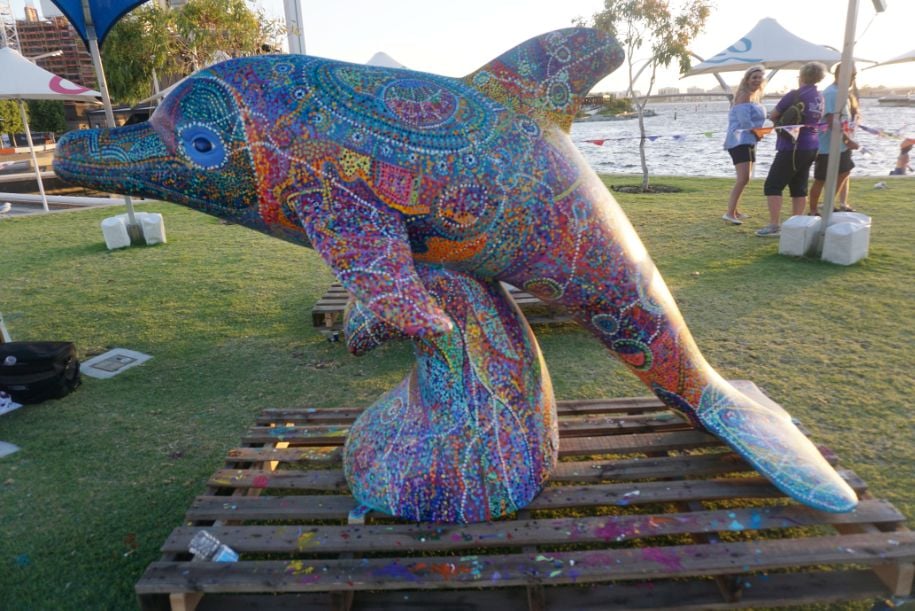
Acrylic on fibreglass dolphin sculptures, 127 (h) x 230 (l) x 96 (w) cm.Pebbles, named after one of the dolphins that lives in the Swan River, adult male who was first sighted and recorded by the River Guardians Dolphin Watch project in 2009.
Giant Teacup Sculpture, 2018
Australia’s Biggest Morning Tea Project commissioned by Lendlease
A community project to paint vibrant designs and dots onto a Giant Teacup Sculpture with Aboriginal Artist Deborah Bonar with the local community at Lakeside Joondalup Shopping City Centre. Community members of all ages participated in a series of interactive art workshops conducted over fours days on the 22, 23 ,24 May and 2 June 2018.


.JPG "Painted Giant Teacup sculpture detail 2")
.JPG "Lendlease Biggest Morning Tea Giant Teacup sculpture")
.JPG "Painted Giant Teacup sculpture detail 3")
Acrylic on fibreglass giant teacup sculpture measuring 164 high x 213cm wide including handle.The Giant Teacup Sculpture was created to raise awareness of the Cancer Council through Australia's Biggest Morning Tea. Preliminary design by Deborah Bonar and Milly Herbert during preparation of artwork.
Giant Teacup Sculpture, 2018 Artwork by Deborah Bonar with community


Healing and Wellbeing, 2014 Percent for Art Project for the South Metropolitan Area Health Service where the four paintings are displayed in Armadale Hospital.
This series of paintings titled Healing and Wellbeing illustrates the link between health and the social, emotional and cultural wellbeing of Aboriginal people. Artist Deborah Bonar completed the four large acrylic paintings titled – Birth, Ageing, Strong Women and Bush Medicine in 2014 with the unveiling February 7.These paintings are featured in a brochure to publicise the WA Government's Percent For Art Scheme.
Healing and Wellbeing SMHS brochure.pdf


.jpg "Birth, 2014")
.jpg "Ageing, 2014")
Rainbow Sunset, 2019
Artwork by Deborah Bonar
Perth Children's Hospital
This artwork titled Rainbow Sunset was commissioned for the Child and Adolescent Health Services, Perth Children's Hospital, located at the entrance to the Neonatal Intensive Care Unit. A 1.5 x 1m acrylic painting on canvas.
.jpg "Rainbow Sunset, 2019")
Pundulmurra Landscape
Percent for Art Project - Pundulmurra Health and Community Services Training Centre, Pilbara Institute
Aboriginal artist Deborah Bonar created this public art commission for the Pundulmurra Health and Community Services Training Centre, Pilbara Institute, in South Hedland. A 2.6m x 45cm acrylic on Belgian linen artwork reproduced onto external glass panels of the courtyard wall integrated into the building.The aim of this project was to create original artwork in a way that will provide an inspiring and stimulating experience for clients, staff and visitors to the campus making the location an interactive, supportive and engaging environment promoting health and wellbeing in mind, body and spirit through education and knowledge.
Pundulmurra Health and Community Services Training Centre brochure.pdf


.JPG "Pundulmurra printed glass sample")
.jpg "Pundulmurra Health and Community Services")

.jpg "Pundulmurra Health external glass panels")


.JPG "Pundulmurra printed glass sample")

.JPG "Pundulmurra printed glass blue sample")
Pundulmurra Landscape, 2017 Artwork by Deborah Bonar 2.6m x 45cm, Acrylic on Belgian linen

Welcome to Country
Percent for Art Project - Fiona Stanley Hospital
Deborah Bonar was commissioned with three other artists, Wendy Hayden, Joanna Robertson and Ella Taylor, to create public artwork for the entrance to the new Fiona Stanley Hospital. This included a 2.45 x 3.3 metres ochre and mixed media painting on canvas titled Welcome to Country plus sixteen metres of artwork reproduced on glass.The theme for both artworks relates to the site of the hospital and its significance to the local Nyoongar people. It features grasses and plants, insects and small creatures from the local wetlands.


Welcome to Country, 2014
Artwork by Deborah Bonar, Wendy Hayden, Ella Taylor & Joanna Robertson


Living Waters
Cockburn Integrated Health Facility
Deborah Bonar created this public art commission in collaboration with two other artists, Wendy Hayden and Joanna Robertson, for the City of Cockburn Integrated Health Facility in 2014.
They created a large acrylic painting titled Living Waters, which was photographed in high detail and then printed onto glass panels, forming the sides and ceiling of the two airlock entranceways.


.jpg "Inspiring glass mural in the Perth suburbs.")


.jpg "Cockburn public art commission collaboration.")
.jpg "One of Cockburn's glass artwork for the entry.")
.jpg "The development of the painting Living Waters.")
Living Waters, 2014
Cockburn Integrated Health Facility
Artwork by Deborah Bonar, Wendy Hayden, and Joanna Robertson


Birth Place and Childbirth
Percent for Art - St John of God Midland Hospital, Maternity Ward
Deborah Bonar created two major artworks titled Birth Place and Childbirth, acrylic on Belgian linen, for the maternity entry corridor. Each painting measures 101 x 365cm.


Birth Place, 2015
Artwork by Deborah Bonar
101 x 365cm, Acrylic on Belgian linen


Childbirth, 2015
Artwork by Deborah Bonar
101 x 365cm, Acrylic on Belgian linen
The Painting's StoryThis painting represents the fertile Avon Valley and the numerous pools, winding streams and creeks flowing into the Avon River. After birth a child has a strong connection to the waters and the surrounding country their spirit came from.
.png "Artwork just the medicine, midland reporter article, 2015")
Swan River Life
Frasers Property Queens Riverside Q1
Commissioned especially for Queens Riverside Q1 'Lily on Moreau' this large-scale vividly coloured contemporary artwork titled Swan River Life weaves personal stories and memories of the Noongar people’s historic use of the Swan River, and their strong connection to this land and water. The extraordinary artwork measuring 5.25metres by 30cm was painted collaboratively by Gija/Yamaji artist Deborah Bonar, Noongar artist Wendy Hayden and Irish/Australian artist Joanna Robertson.This public artwork is located on the external wall of the Queens Riverside Q1 residential building’s ground floor facing Moreau Parade. This artwork is highly visible from Moreau Parade and also from the public restaurant at Frasers Suites.The artwork is an integrated glass artwork with a vibrant daytime and night-time presence. The size of the artwork is approximately 21metres long x 2.1 metres high. The artwork is a long horizontal work which is dynamic with a sense of ‘flow or movement’ along the long horizontal format.
.jpg "The glass external wall of Queens Riverside Q1 residential buildings")

.jpg "Large-scale vividly coloured contemporary artwork")
.jpg "Visit this public art site opposite the restaurant at Frasers Suites")
Swan River Life, 2015
Artwork by Deborah Bonar, Wendy Hayden, and Joanna Robertson
Acrylic on canvas

Port Coogee-Beeliar Boodjar – Australand
Deborah Bonar created this major public art commission for Australand in collaboration with two other artists, Wendy Hayden and Joanna Robertson. The artists’ team created stunning contemporary artwork comprising of seven separate pieces, reproduced in glass and installed in locations around the new estate at Port Coogee. The project included relocating and transplanting mature grass trees as living sculptures and it was completed in 2013.The artwork titled Port Coogee-Beeliar Boodjar represents the changing seasons, the land and the sea, the wetlands and woodlands and all the creatures who inhabit Beeliar Boodjar.


Port Coogee Beeliar Boodjar, 2013 Artwork by Deborah Bonar, Wendy Hayden & Joanna Robertson Acrylic on canvas, various


Portrait of Diversity
Nomad Two Worlds
Deborah Bonar was commissioned to complete four artworks for the Nomad Two Worlds exhibition, Portrait of Diversity displayed during the 2011 Commonwealth Heads of Government Meeting (CHOGM) in Perth, Western Australia. She embellished four photographic portraits of migrants from different commonwealth countries.
The outdoor display in Murray & Hay Street Mall, Perth, Western Australia. Photographs from the opening of the exhibition.


.jpg "Portraits of migrants in Murray & Hay St Mall")
.jpg "Portrait of Diversity, 2011 collaborative artwork")


.jpg "Portrait of Diversity, 2011 preparations")
.jpg "Portrait of Diversity, 2011 portrait art")

Woman of Passion, 2011 60" x 40" Archival inkjet on canvas with acrylic applications. Photograph by Murray Hall. Collaborative art by Deborah Bonar. Portrait subject, Shaniquoa Elrington, Belize.

Tribal, 2011
60" x 40" Archival inkjet on canvas with ochre applications.
Photograph by Murray Hall. Collaborative art by Deborah Bonar. Portrait subject, Jacob Emmanuel, St Lucia.

Hibiscus Girl, 2011
60" x 40" Archival inkjet on canvas with ochre applications.
Photograph by Andrew Miller. Collaborative art by Deborah Bonar. Portrait subject, Dorothy Lawrance, Solomon Islands.
Memories, 2011
60" x 40" Archival inkjet on canvas with acrylic and ochre applications.
Photograph by Andrew Miller. Collaborative art by Deborah Bonar. Portrait subject, Marcelline Newitt, Vanuatu.
Enjoy cultural storytelling through samples of Aboriginal artist Deborah Bonar's artwork.

Ruby's Country
2013, acrylic on canvas, 122 x 76cm
This painting represents the heat and humidity of the wet season in Gija country in the East Kimberley, where my great grandmother, Ruby, was born. The women would gather bark, dry wood and leaves for a smoking ceremony for their babies. This made them strong and healthy and healed them when they were sick.
Mundaring
2013, acrylic on canvas, 31 x 31cm
Natural bushland, forests, open spaces, fresh air, native birds, animals and wildflowers. Mundaring Weir, Lake Leschenaultia, the Helena River. Magnificent sunrises and sunsets.Arts and crafts, roadside stalls, markets, fresh produce, fruit, vegetables, eggs and honey. What more could you possibly wish for?
Precious
2012, acrylic & ochre on canvas, 122 x 92cm
Iron ore and diamonds are mined from the rich red earth and rugged hills of the Pilbara and the East Kimberley. Waterholes, billabongs, pools and soaks are sprinkled in the desert sand hills. Water, the most precious jewel of all, gives life to the people, the animals, birds, insects and plants.
Thunder, Lightning and Rain
2011, acrylic on Belgian linen, 122 x 76cm
During cyclone season, the heavens open and send a flood of rain upon the land. Lightning crackles and sizzles and thunderclaps blast the air. I have use vibrant acrylics to capture the excitement and energy of the storm in a rainbow of colours.
Country Music
2010, acrylic & ochre on violin with case,
This artwork features the East Kimberley. The front portrays Purnululu (the Bungle Bungles) and the back portrays a sea turtle and barramundi. Invited to donate artwork Country Music, to the Perth Modern School to raise funds in their Artstrings auction.